
Politics, Presidents, and the Stock Market: A Little Historical Perspective
By George Howe
I know, I know…it’s the end of civilization!!! Oh wait, never mind, AI is going to kill us all in 10 years anyway so none of this really matters but figured I would opine anyway. With the midterm elections behind us and another presidential election approaching in 2028, I’ve had a number of conversations with clients concerned about what a potential change in political leadership might mean for their investments.
Some worry about Democrats controlling Congress and potentially the White House. Others have expressed similar concerns when Republicans are in control.
Regardless of your political preferences, I think it’s worth looking at what history actually tells us.
The stock market has performed well under both Republican and Democratic presidents. And while Washington certainly influences economic policy, the relationship between politics and investment performance isn’t nearly as straightforward as we might think.
A Look Back at the Presidents
Consider the past several decades. We’ve experienced strong stock markets under Presidents Reagan, Clinton, Obama, Trump, and Biden, despite dramatically different approaches to taxes, regulation, government spending, and economic policy.
We’ve also experienced difficult markets under both parties.
What matters is that the market doesn’t operate on a four-year political calendar. Companies continue to innovate, consumers continue to spend, and businesses continue to pursue profits regardless of who occupies the White House.
What About Control of Congress?
Here’s another interesting historical observation: The S&P 500 has generated positive average annual returns under unified Democratic government, unified Republican government, and various combinations of divided government.
In other words, investors haven’t needed one particular political party in power to experience long-term investment success.
Certainly, elections have consequences. Tax policy, regulation, government spending, and international trade can all influence financial markets. These are important considerations in the financial planning and investment management process.
But attempting to predict stock market performance based solely on election results is an entirely different proposition.
The Real Risk May Be How Investors React
One of the biggest challenges investors face isn’t necessarily the market itself. It’s the temptation to make emotional decisions in response to political headlines.
Imagine an investor who moved their entire portfolio to cash because they disliked the outcome of the 2016 or 2020 presidential election. Depending on when they reinvested, they could have missed significant market gains.
And that brings us to a fundamental investment principle: Your political opinions and your investment decisions don’t necessarily belong in the same conversation.
We can have strong opinions about government policy while recognizing that successful long-term investing requires a different mindset.
Our approach remains focused on the things we can control: diversification, risk management, tax efficiency, portfolio construction, and a financial plan designed around your individual goals.
Presidents come and go. Congress changes hands. Markets fluctuate. Your long-term financial plan should be designed to endure all three.
Here are a couple of charts to illustrate these points:
Chart 1 — S&P 500 performance by president
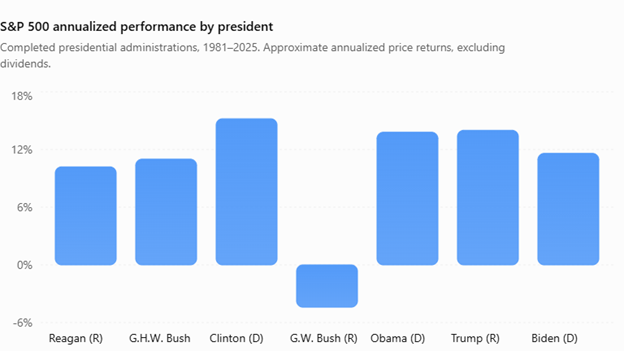
Source: Allianz Bernstein Research Services. Historical S&P 500 price performance, approximately measured across each administration. Excludes reinvested dividends. The current presidential term is excluded because it is incomplete.
Chart 2 — Historical market performance by political party
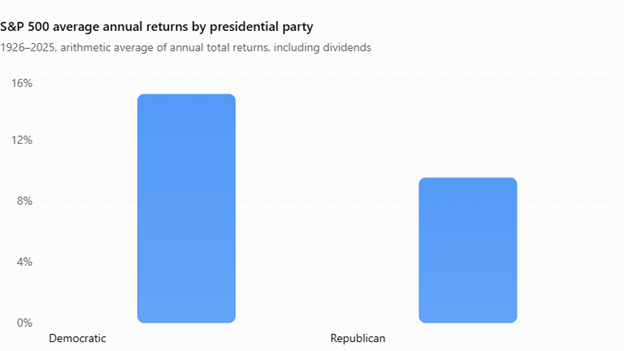
Source: Westwood historical analysis, 1926–2025. Calendar-year arithmetic averages, not compounded returns. The differences do not establish that presidential party affiliation caused the returns.
And last but never least, the disclosure: Past performance is not indicative of future results. Historical returns are provided for informational purposes and do not imply a causal relationship between political leadership and market performance.